

- All
- Product Name
- Product Keyword
- Product Model
- Product Summary
- Product Description
- Multi Field Search
Views: 0 Author: Site Editor Publish Time: 2026-10-02 Origin: Site


The rapid expansion of modern transit relies heavily on robust electrification infrastructure. Across the globe, the 25kV alternating current standard has become the definitive backbone for high-speed rail and heavy-haul freight networks. This voltage provides an optimal balance. It delivers the massive power required for rapid acceleration and heavy payloads while minimizing transmission losses over long distances. However, the overhead catenary systems that deliver this power operate in some of the most unforgiving dynamic environments on the planet.
A failure in the insulation of these overhead lines does not just cause a minor delay. It results in massive network downtime, severe safety hazards, and catastrophic electrical faults. For decades, traditional porcelain and glass were the default materials for these critical components. Today, the modern industry standard has shifted. Engineering teams now specify the 25kV composite railway suspension insulator to replace legacy materials. This shift is driven by superior mechanical strength, advanced electrical properties, and exceptional resistance to environmental degradation.
This comprehensive guide breaks down exactly which types of composite insulators are best suited for 25kV systems. We explore how specific catenary designs influence selection, the environmental demands these components must endure, and the fundamental reasons why procurement engineers are standardizing silicone-based composite technology for overhead line equipment.
Material Superiority: Composite materials provide unmatched surface hydrophobicity, significantly lighter weight, and high vandalism resistance compared to traditional porcelain or glass alternatives.
Application-Specific Selection: Proper specification strictly depends on the component's function within the catenary system. Distinct designs are required for suspension, tension, post, or sectioning applications.
The Core Backbone: The suspension-type insulator serves as the critical support of the overhead line equipment, bearing sustained vertical loads while ensuring complete electrical isolation from the steel mast.
System-Level Design Impact: Catenary engineering variables like train speed, track curve radius, and regional pollution levels directly dictate the necessary Specified Mechanical Load and creepage distance.
Long-Term ROI: Correct specification and proactive maintenance of these units drastically reduce total lifecycle costs by mitigating installation labor and preventing costly pollution flashover failures.
Recent industry reports highlight a massive global shift toward climate-resilient railway grids and predictive maintenance. As extreme weather events become more frequent, infrastructure managers are abandoning brittle ceramics. Modern high-speed rail networks are pushing operational speeds beyond 300 km/h, which introduces violent aerodynamic vibrations into the overhead lines. To combat this, procurement teams are heavily favoring advanced silicone polymers capable of absorbing intense dynamic shock loads without fatiguing.
Furthermore, the integration of smart-grid monitoring into railway power systems means that any minor leakage current is instantly detected. This zero-fault tolerance environment makes the reliability of insulation more critical than ever. The market is seeing a clear standardization of High-Temperature Vulcanized silicone rubber, especially in coastal and heavily industrialized rail corridors where pollution flashovers previously caused millions in downtime losses.
To fully grasp the demands placed on railway insulation, one must understand the operational reality of the 25kV standard. Railway electrification requires transmitting immense amounts of electrical energy to moving locomotives. Pushing 25,000 volts through open-air infrastructure allows operators to transmit massive power with lower current. This cuts down the required copper cross-section and slashes conductive energy losses over vast geographic stretches. But containing that voltage requires highly engineered electrical barriers.
Overhead line equipment is entirely exposed to the elements and subjected to relentless mechanical abuse. Imagine a heavy-haul freight train laboring through a coastal blizzard, or a high-speed passenger train tearing through an arid valley. The unique challenges these systems face include severe dynamic mechanical vibrations. As a train travels at high speeds, the pantograph pushes upward against the contact wire. This interaction creates a violent, high-frequency mechanical wave that propagates down the catenary line, subjecting the supporting hardware to constant shock loads.
Infrastructure must also maintain its structural integrity during gale-force winds and severe ice accumulation. Ice buildup increases the vertical dead-weight load and threatens to bridge the silicone sheds, potentially causing an electrical short circuit. Additionally, railway corridors are frequently exposed to heavy industrial dust, diesel exhaust particulates, and coastal salt fog. When these conductive pollutants settle on a surface and mix with moisture, they create a dangerous pathway for leakage currents.
For procurement engineers looking to upgrade existing lines or specify components for new high-speed projects, the transition from porcelain to advanced polymers is driven by empirical performance data. The operational efficiency gained on the track is undeniable.
One of the most immediate benefits of composite materials is their reduced mass. Manufactured with a fiberglass core and a silicone rubber housing, these units are up to 70 percent lighter than their porcelain equivalents. This drastic reduction in weight fundamentally changes field operations. During narrow midnight track-possession windows, hoisting a heavy porcelain unit requires specialized cranes and extensive rigging. In contrast, a technician can manually lift and secure a composite unit. This significantly cuts labor costs, accelerates project timelines, and reduces the permanent dead load on the cantilever tubes.
The defining electrical advantage lies in the intrinsic hydrophobic properties of the silicone rubber housing. Instead of allowing moisture to form a continuous conductive film across the surface, silicone forces water to bead up into isolated droplets. High-quality silicone rubber also transfers this hydrophobicity to the layer of pollution resting on its surface. This unique chemical transfer drastically reduces leakage currents and virtually eliminates the risk of pollution-induced wet flashovers.
Performance Metric | Traditional Porcelain | Advanced Composite Silicone |
|---|---|---|
Weight & Installation | Heavy, requires cranes and heavy rigging. | Up to 70% lighter, allows manual installation. |
Pollution Resistance | Hydrophilic surface; prone to wet flashovers. | Hydrophobic transfer; excellent in heavy pollution. |
Impact Resistance | Highly brittle; shatters from vandalism or drops. | Shatter-proof; absorbs blunt impacts safely. |
Maintenance Needs | Requires periodic washing in polluted zones. | Self-cleaning properties; practically maintenance-free. |
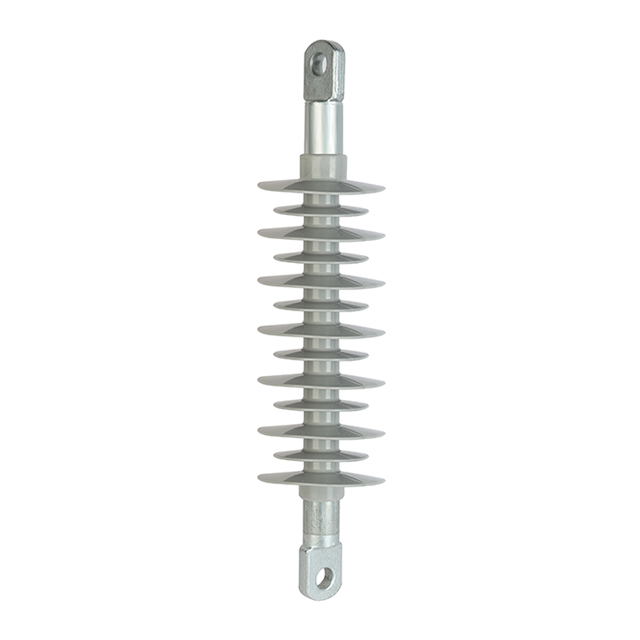
Selecting the correct hardware is never a one-size-fits-all process. The overhead line equipment utilizes different configurations based entirely on the specific direction and magnitude of the mechanical loads they must bear. Specifying the right composite railway insulators ensures the physical geometry of the catenary remains stable under passing trains.
The suspension insulator acts as the primary backbone of the entire network. It is utilized to suspend the messenger wire and the contact wire from the portal structure or the cantilever arm. Engineered primarily to handle sustained vertical dead-weight loads and tensile stress, it plays a critical role in maintaining the precise height and geometric stagger of the contact wire. Any deformation or mechanical creep here causes the wire to sag, leading to dangerous pantograph arcing or physical entanglement at high speeds.
Tension insulators are deployed at anchor points, termination masts, and sharp railway curves. Their specific job is to hold the immense longitudinal horizontal tension of the overhead wires. Because catenary wires are mechanically tensioned to keep them perfectly flat for passing trains, these units require exceptionally high Specified Mechanical Load ratings. They typically range from 100kN to 160kN. They feature heavily reinforced cores and specialized forged steel end-fittings to prevent core pull-out under extreme, continuous strain.
Post insulators structurally support the cantilever tubes, mounting them either horizontally or at a specific upward angle from the main steel mast. Unlike suspension or tension types that deal primarily with pulling forces, post configurations must withstand high bending moments and compressive forces. To accommodate this, they require a significantly thicker fiberglass core diameter to provide necessary stiffness. This ensures the cantilever arm does not flex downward under the weight of the wires or the upward thrust of the passing train.
Procurement and engineering teams cannot select hardware based on voltage alone. The macro-level design of the railway infrastructure directly dictates the micro-level specifications of the components.
The operational speed of the railway corridor is a primary determining factor. High-speed rail networks require catenary systems with extremely high mechanical tension to prevent wave-propagation delays in the wire. Insulators in these advanced systems must possess higher stiffness and superior vibration dampening capabilities. If a suspension unit introduces excessive mass or flexibility into the system, it will alter the dynamic interaction between the wire and the pantograph, leading to accelerated wear and dangerous contact loss.
Railway tracks are rarely perfectly straight. When a track enters a tight curve, the overhead wires naturally want to pull straight, creating severe radial loads toward the inside of the curve. At these specific locations, standard suspension units are entirely insufficient. Engineers must specify heavy-duty tension insulators with reinforced epoxy-resin fiberglass cores and enhanced crimping on the end-fittings to safely manage the continuous outward pulling force.
In complex infrastructure environments such as historic tunnels, underpasses, and low-clearance bridges, spatial real estate is strictly limited. The distance between the live 25kV wire and the grounded tunnel ceiling is often minimal. In these scenarios, engineers cannot use standard-length hardware. Instead, they must specify units with shorter structural lengths. To ensure the electrical creepage distance is not compromised, these specialized units utilize alternating shed profiles. Combining large and small silicone skirts maximizes the surface tracking distance within a highly constrained physical footprint.
Evaluating the technical data sheet is the most critical step in the sourcing process. A high-quality 25kV composite suspension insulator must meet strict international metrics to guarantee field safety and ensure a multi-decade lifespan.
Creepage distance is the shortest path along the surface of the insulator from the high-voltage end to the grounded end. The required distance is dictated by the IEC 60815 standard, which categorizes pollution severity into specific classes. For a 25kV or 27.5kV system in a heavily polluted coastal or industrial area, a creepage distance exceeding 1200mm to 1600mm is often mandatory. Specifically, an alternating shed design is frequently specified to optimize self-cleaning during rainstorms and prevent ice from forming continuous bridges between the skirts.
Mechanical failure in the catenary is simply not an option. Data sheets list two primary mechanical ratings that engineers must scrutinize. The Specified Mechanical Load represents the ultimate load the unit is guaranteed to withstand before structural failure occurs. The Routine Test Load is usually set at 50 percent of the Specified Mechanical Load. This is the exact load applied to every single unit during factory quality control testing to ensure manufacturing consistency. For standard 25kV applications, suspension units typically require a Specified Mechanical Load of 70kN to 100kN, whereas heavy-duty tension units require 120kN or more to handle horizontal strain.
The longevity of the product relies entirely on the purity and engineering of its raw materials. The core must be an epoxy-resin fiberglass rod, which is boron-free and offers exceptional resistance to acid attack and brittle fracture. The housing should be formulated from High-Temperature Vulcanized silicone rubber containing aluminum trihydrate fillers to maximize UV radiation resistance and electrical tracking resistance. Finally, the end fittings must be hot-dip galvanized steel or forged aluminum, attached via a highly controlled multi-directional crimping process to ensure maximum grip without crushing the internal fiberglass.
Even the highest-grade materials will fail prematurely if not properly tested, handled, and maintained in the field. A reliable product must comply with stringent international standards. Procurement specifications should mandate compliance with IEC 61109 for composite suspension and tension insulators, and EN 50151 specifically tailored for railway applications. Manufacturers must provide transparent documentation for Design Tests, Type Tests, and Routine Tests, verifying every batch before it leaves the facility.
While shatter-proof, silicone rubber remains susceptible to sharp cuts and deep abrasions. During installation, field crews must follow strict handling protocols. Units must never be dragged across gravel ballast. Workers must avoid walking on the silicone sheds. When hoisting the hardware into place, only approved nylon belts should be used around the metal end fittings. Abrasive steel wire ropes should never come into contact with the rubber housing.
Composite materials are generally marketed as maintenance-free, as they do not require the expensive periodic washing that legacy porcelain demands. However, routine visual inspections remain a necessity. Maintenance teams should utilize high-powered optics or drone technology to inspect for corona tracking near the high-voltage fittings, physical damage from bird pecking, or severe UV chalking that could indicate a loss of surface hydrophobicity.
Selecting the right manufacturing partner is just as critical as selecting the right technical specifications. When sourcing components for critical transit infrastructure, rigorous due diligence is required. Look for manufacturers that hold current ISO 9001 quality management certifications. More importantly, request independent laboratory test reports. Certifications from internationally recognized high-voltage laboratories prove that the manufacturer's claims regarding electrical and mechanical performance are objectively verified.
Railway standards vary wildly between different global regions. European EN standards differ slightly from North American AREMA standards or Chinese railway standards. An established manufacturer must possess the engineering capacity to customize end-fittings, offering clevis, tongue, ball, or socket connections, and adjust shed profiles to meet exact regional clearance and pollution requirements.
When upgrading or designing a new overhead line, consulting with specialized manufacturers ensures system compatibility and long-term reliability. Engineers and procurement teams can review detailed technical data sheets and explore customized options for a single insulated suspension composite insulator for railways to secure their 25kV catenary projects against future electrical and mechanical failures.
Choosing the right insulation technology keeps railway systems safe and ensures long-term operational efficiency for modern transit networks. As train speeds increase and environmental conditions become more unpredictable, the demands placed on overhead line equipment will only grow. Transitioning to high-quality silicone composite models lowers overall lifecycle maintenance costs and effectively stops sudden power failures caused by shattered porcelain. By carefully matching the hardware type to the specific mechanical loads of the catenary design, engineers guarantee safe, fast, and uninterrupted train travel for decades to come.
Typically, these units last 15 to 25 years or more in the field. The exact lifespan heavily depends on environmental factors like continuous UV exposure, regional pollution severity, and the specific chemical quality of the silicone rubber used during the manufacturing process.
While no electrical component is completely immune to failure, the intrinsic hydrophobic nature of silicone rubber drastically reduces wet flashovers compared to traditional porcelain. This makes them the safest and most reliable choice for heavily polluted, industrial, or coastal railway environments.
Manufacturers utilize strict IEC standards for quality control. Standard procedures include rigorous visual inspections, hydrophobicity classification testing to measure water contact angles, and high-voltage electrical tests like power frequency withstand voltage tests to ensure zero internal defects before shipping.
Yes. High-quality silicone rubber maintains its mechanical flexibility and structural integrity in extreme temperatures as low as -50 degrees Celsius. Furthermore, the flexible sheds naturally shed snow and prevent the dangerous ice-bridging issues that commonly plague rigid porcelain alternatives.
Higher pollution levels dictate longer creepage distances. In clean environments, a standard creepage distance might suffice. However, in heavy industrial or coastal salt-fog zones, engineers must specify extended creepage distances, often exceeding 1200mm, to prevent conductive contaminants from creating a path for leakage currents across the surface.
Suspension insulators are designed primarily to hold vertical dead-weight loads, keeping the messenger and contact wires suspended above the track. Tension insulators are built to withstand immense horizontal pulling forces at anchor points and track curves. Consequently, tension units require a much higher Specified Mechanical Load rating and thicker fiberglass cores.


