Selecting a high-voltage Insulator is not merely a materials procurement task. It operates as a critical grid reliability and risk-mitigation decision for modern infrastructure. Engineers and planners face a stark operational reality daily when designing substations and overhead lines. Incorrect specification directly leads to accelerated aging and elevated maintenance demands. Maintenance teams might be forced into complex, hazardous aerial inspections just to find a single failing unit. Worse, poor component choices frequently trigger catastrophic line faults due to sudden surface flashovers or internal material punctures. This guide establishes a clear framework for evaluating different component shapes and material lifecycles. You will learn how to balance core electrical and mechanical performance criteria against standard engineering tolerances. We also examine how harsh environmental variables alter laboratory performance. You will leave equipped with actionable steps to specify resilient, fail-safe components for your power network.
Key Takeaways
Voltage and load dictate form: Transmission vs. distribution requires strictly different form factors, with suspension disc arrays acting as the modular standard for high voltages (>33kV).
Environment overrides baseline materials: Coastal, industrial, and high-humidity zones require specific material interventions (e.g., polymer hydrophobicity or RTV coatings) to prevent wet-condition flashovers.
Fail-safe engineering is mandatory: The ideal insulator design ensures that external flashovers occur long before irreversible internal material punctures.
1. Defining the Baseline: Matching Insulator Type to Grid Architecture
Categorizing equipment shapes based on load-bearing purpose and voltage thresholds helps narrow your procurement choices. Different sections of the power grid require distinctly engineered profiles to manage varying mechanical stresses safely.
Pin vs. Post Insulators (Distribution & Substations)
Distribution networks and substations rely heavily on rigid support structures. They face unique spacing and load requirements.
Pin Insulators: These offer a highly cost-effective solution for straight-line distribution poles. However, they face strict physical limits. Engineers generally cap their deployment at approximately 33kV. Pushing them beyond this limit invites severe flashover risks because their physical profile cannot provide adequate arcing distance.
Post Insulators: These feature a much heavier profile and deliver superior vertical load-bearing capacity. Grid planners specify a high-quality Insulator in a post configuration for compact substations and switchgear. In these environments, mechanical rigidity remains paramount to keep heavy conductive busbars perfectly aligned during thermal expansion.
Suspension & Strain Insulators (High-Voltage Transmission)
Moving up to transmission-level voltages requires a shift from rigid supports to flexible, modular systems.
Suspension Modules: This modular disc design allows easy scaling up to 765kV and beyond. Operators simply link more discs together as line voltage increases. If one disc fails, the remainder of the string often remains fully functional. This fault-tolerant behavior drastically reduces immediate outage risks and prevents lines from dropping to the ground.
Strain Applications: Installation crews deploy these modules horizontally at dead-ends, sharp corners, or long river crossings. They absorb maximum horizontal conductor tension. They prevent high-stress points from ripping towers apart.
Field Estimation Metric: In standard North American applications, engineers use a baseline rule of thumb. They estimate roughly 10kV of insulation capacity per standard disc. However, safety over-engineering and environmental padding frequently alter these actual field counts.
The table below summarizes these architectural baseline rules:
Insulator Type | Primary Application | Voltage Threshold | Key Engineering Strength |
Pin | Straight distribution lines | Up to 33kV | Cost-effective, simple installation |
Post | Substations, switchgear | 11kV to Extra-High Voltage | High rigidity, superior vertical support |
Suspension | High-voltage transmission | 33kV to 765kV+ | Modular scaling, fault-tolerant |
Strain | Dead-ends, corners, crossings | 33kV to 765kV+ | Maximum tension absorption |
2. Material Evaluation: Aligning Lifecycle Costs with Operating Environments
Evaluating the "Big Three" materials requires looking at inspection ease, durability, and operational longevity. We must carefully balance upfront investments against long-term maintenance budgets and regional climate challenges.
Toughened Glass: The Low-Maintenance Standard
Glass offers a massive inspection advantage for utility companies managing thousands of miles of lines. It features a unique zero-value self-explosion mechanism. Defective or aging discs shatter completely upon failure, leaving a highly visible stub behind. This enables rapid, ground-level visual audits. Maintenance teams can spot failures via binoculars or drones without relying on expensive electrical diagnostic tools. Even when the glass umbrella breaks off, the remaining stub retains more than 80% of its core mechanical and electrical strength. You avoid emergency line drops. Glass components boast an extremely low degradation rate, and their lifespans frequently exceed 50 years.
Porcelain / Ceramic: The High-Dielectric Legacy
Porcelain provides an exceptional performance profile built on decades of field data. It delivers incredible dielectric strength, hitting approximately 60 kV/cm. The ceramic glaze also provides high intrinsic resistance to severe UV aging and thermal cycling. Utilities often prefer ceramic for heavy-load, high-tension environments. They accept the heavier installation weight because porcelain guarantees long-term stability. Prioritizing initial capital expenditure over lightweight installation makes strategic sense when building backbone transmission routes.
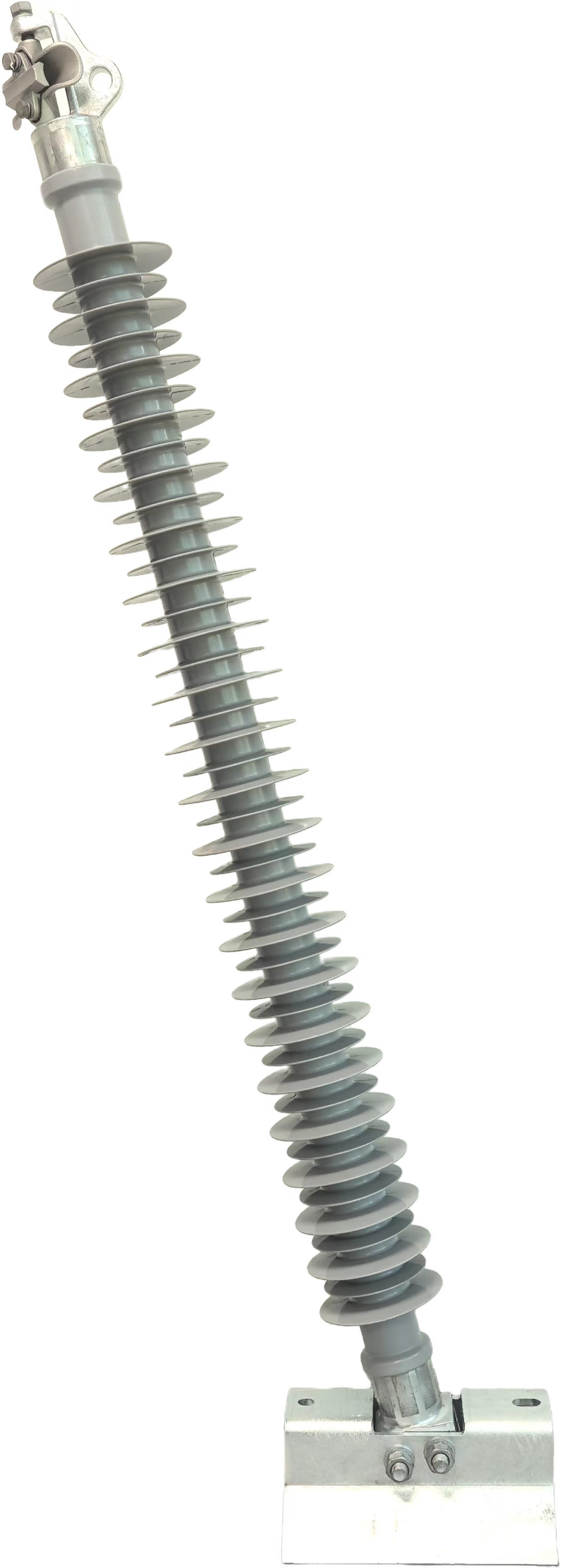
Polymer & Composite: The Anti-Pollution Solution
Modern composite options feature a central fiberglass core wrapped in a weather-shedding polymer housing. They easily support ultra-high voltages up to 800kV while remaining significantly lighter than glass or porcelain. Their primary operational edge is innate hydrophobicity. The polymer surface actively prevents water filming. It forces moisture to bead up and roll away, carrying dirt with it. This self-cleaning action makes them the superior choice for coastal salt-fog or heavy industrial pollution zones. The main trade-off involves ultimate longevity. Polymer materials remain more vulnerable to severe biological degradation, bird damage, and slow environmental tracking over decades compared to inorganic glass or porcelain.
3. Core Electrical & Mechanical Evaluation Criteria
Procurement and design teams must verify exact engineering metrics before shortlisting vendors. A properly rated Insulator guarantees safety and continuous operation under extreme duress.
Creepage Distance Requirements
Creepage represents the total surface path length measured from the live conductor wire to the grounded support structure. This distance prevents surface tracking. The baseline standard typically sits around 20 to 25 mm/kV for clean environments. However, highly contaminated environments require significant multipliers. An industrial zone might demand upwards of 31 mm/kV to prevent dangerous arcing across dirt-coated surfaces.
The Safety Factor: Flashover vs. Puncture Resistance
Understanding failure modes keeps grids secure. We classify failures into two distinct physical events:
Flashover (Air Arc): A disruptive electrical discharge traveling through the air surrounding the hardware. It happens externally and is usually non-lethal to the physical device. Once the overvoltage clears, the component often resumes normal operation.
Puncture (Material Breakdown): A direct electrical discharge ripping through the solid solid body. This causes permanent, irreversible failure. The material burns entirely through, requiring immediate replacement.
Evaluation logic mandates a robust safety factor. You calculate this by dividing Puncture Strength by Flashover Voltage. The overall design must guarantee an overvoltage event flashes over the outside surface long before it ever punctures the solid core. Fail-safe engineering relies entirely on this specific mathematical ratio.
Mechanical Load Tolerances
Hardware must account for the static weight of heavy conductive cables. It must also handle dynamic load forces. Wind sheer creates extreme horizontal strain. Ice accumulation doubles or triples the vertical dead-weight. Severe lateral tension pulls heavily on strain towers during winter storms. Engineers specify cantilever strength limits for post models and tensile load limits for suspension strings to combat these natural forces.
4. Environmental Derating and Contamination Mitigation
Real-world field conditions routinely compromise laboratory-rated performance. Engineers must understand how to navigate around these degrading variables to keep the power flowing.
Moisture and Flashover Degradation
Heavy rain, dense fog, or morning condensation severely impacts electrical resistance. Wet conditions can reduce standard dry flashover thresholds by up to 50%. This harsh reality necessitates strict adherence to wet-testing data during any vendor evaluation. Never base procurement decisions solely on dry-test numbers. Planners must calculate the worst-case scenario using regional rainfall data.
Combating Severe Contamination (Salt & Chemical)
Salt accumulation from ocean spray and chemical dust from industrial plants trigger catastrophic electrical tracking. We utilize two primary interventions to fight this surface degradation.
Surface Additions: Maintenance teams frequently apply Room Temperature Vulcanizing (RTV) silicone coatings directly onto existing glass or porcelain units. This chemical layer introduces artificial hydrophobicity. It forces contaminated water to bead and roll off, effectively cleaning the surface and restoring insulation values.
Hardware Protection: Engineers integrate sacrificial zinc rings or sleeves at the critical pin-to-cement junction. These metallic rings actively absorb galvanic corrosion. They sacrifice themselves to protect the main hardware pins from rusting away in harsh marine environments.
5. Shortlisting Logic: Vendor Compliance and System Integration
Finalizing a specification sheet requires actionable steps and strict oversight. Overlooking system integration creates weak links across the network.
Hardware Fitting Compatibility
Ensure your chosen designs align seamlessly with specified line hardware. This includes verifying fitment for vibration dampers, spacer cables, arcing horns, and suspension clamps. Mismatched hardware creates localized mechanical stress points. These micro-stresses cause early component fatigue and eventual mechanical snapping.
Testing & Certification Standards
Always require documented compliance with primary international testing standards. Look for IEC, ANSI, or IS certifications specific to your deployment region. Check the testing laboratory credentials. Vendors should willingly provide independent type-test reports covering thermal cycling, steep-front impulse voltage, and electromechanical failing load tests.
Pilot Testing for Extreme Zones
Micro-climates often experience unusually high failure rates due to localized pollution. We highly recommend small-batch pilot installations for these unique zones. Install a dozen specialized units and measure specific contamination accumulation over a few months. Gather actionable data regarding leakage currents before rolling out the specification across the entire grid segment.
Conclusion
Choosing the right line equipment remains a careful, calculated balancing act. You must align exact voltage requirements against environmental stress variables and long-term maintenance budgets. Keep these action-oriented steps in mind as you finalize your project requirements:
Cross-reference your intended creepage requirements with local pollution mapping before releasing a final RFQ.
Select material based on specific environmental challenges. Deploy polymer for heavy salt fog and specify glass for ease of rapid visual inspection.
Prioritize designs where the safety factor ensures external flashovers happen long before internal material punctures.
Verify hardware fitting compatibility early in the design phase to avoid mechanical stress failures at crucial junction points.
FAQ
Q: Can you estimate transmission line voltage by counting insulator discs?
A: Yes, as a rough field guide, one standard disc equates to roughly 10kV of insulation capacity. For example, a 230kV line often uses 12 to 14 discs. However, climatic derating and safety over-engineering frequently result in more discs than strictly necessary for the baseline voltage.
Q: Why is glass preferred by some maintenance teams over porcelain?
A: The preference stems from its unique failure mechanism. Toughened glass shatters visibly but retains core mechanical strength. This zero-value self-explosion eliminates the need for expensive instrumental testing. Maintenance crews can easily find "dead" units on a long string visually from the ground.
Q: What is the minimum creepage distance for an 11kV distribution line?
A: In standard atmospheric conditions, an 11kV system typically requires a minimum creepage distance between 300 and 350 mm. You must scale this number upward significantly if the line operates in heavy industrial or marine pollution areas to prevent dangerous surface tracking.


